Newcastle, being a walled and vulnerable town for much of its history, didn’t have much room for the likes of cricket in yonder times. And, as it quickly exploded during the Industrial Revolution and beyond, there was barely enough living space, never mind the large expanse of level grass needed for the game. Besides, cricket was slow to catch on up here in the North-East, of course.
By around 1800, cricket looked pretty much as we know it today: straight bat (instead of curved), three stumps instead of two, and match statistics were being properly recorded. It was especially popular down south, with the MCC, for example, being formed in 1787. Up here, it took a little longer to infiltrate society’s leisure time; though town historian Mackenzie, writing in 1827, says that “one or two cricket clubs” were playing on the Town Moor.
Before the formation of a national ‘England’ team, the famous ‘All England XI’, formed in 1846, toured the country widely, popularising the game. Between 1847 and 1850, this pioneering team played several matches across the North-East, including Newcastle. They were usually three-day affairs, and were a mixture of amateurs and professionals, the sides often being of unequal numbers to even up the match. In those early years, the All England team won all their games in the region, bar a match played at Newcastle in 1847 against the Northumberland Cricket Club, which ended in a draw (the local side used 20 players including a couple of Yorkshire pros and a handful of leading Scots). By this time, the Northumberland Cricket Club itself had existed for a while (it reportedly played its first match on the Town Moor on 11th July 1838) and had around 150 members. Come the late 1840s – and that prestige match against the All England XI – this club had what would be the only ever ‘real’ cricket ground in the town centre, immediately to the east of the present-day Northumberland Baths (which themselves had been built in 1839). The attractive site was known as the Bath Road Ground – being named after the nearby thoroughfare, which is now known as Northumberland Road – and overlooked the now filled-in Pandon Dene. It was thrown open to the public on match days, and attracted young men in their hundreds. Just to liven things up, they also had their own band … which even exercised their talents during play. Talking of bands, there was also a shadowy cricketing outfit known as ‘Newcastle Clayton’, of which little is known, who also played along to the music!
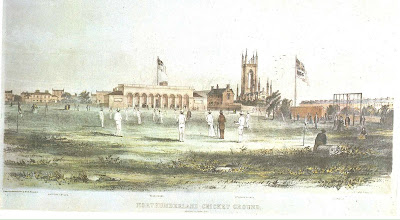
Northumberland CC's Bath Road Ground, c.1850
In time, this ground was swallowed by urban sprawl. In 1881, the land was sold to make way for several notable institutions, including Dame Allan’s School. The club remained in being, but moved around a bit, including playing at Heaton, until it was dissolved in 1895. It was almost instantly reformed, and in 1896-7 set up afresh on Osborne Avenue, Jesmond, taking over an existing ground – and where it remains to this day. From 1877 until 1887, an outfit called ‘Newcastle Cricket Club’ played on a ground subsequently occupied (from 1888) by the Fleming Memorial Hospital in South Jesmond, just off the Great North Road (and not too far from the town/city centre). Many minor clubs continued on the Town Moor, and many more teams represented churches and the like.
Gosforth seems to have been a centre of early sporting activity. Organised cricket began there in the mid 1860s, though South Northumberland Cricket Club emerged as the main force in the early 1880s. ‘South North’, as they came to be known, even had a pro bowler at an early stage and went on to become (and still are) quite a force in the sport. The Town Moor and various other open spaces scattered among the suburbs hosted clubs such as ‘The Mechanics’, ‘The Claremont’, ‘The Newcastle’, ‘The Press’, etc.; and further afield in places such as Benwell, the sport found what often proved to be, eventually, well-established niches in people’s lives. It is worth remembering, too, that Newcastle United FC’s roots lie in South Byker and the ambitions of Stanley Cricket Club, who founded Newcastle East End FC in 1881 (and Newcastle West End FC were also formed by a cricket club a year later, namely West End Junior CC, originally known as the Crown CC).
By 1900, there were around a dozen active Newcastle clubs of substance – all of which, by this time, though, were scattered throughout the suburbs.
[main source: Newcastle-upon-Tyne: Its Growth & Achievement by S.Middlebrook (1950)]
---o---
Perhaps the Bath Road Ground’s most noted cricketing fixture was that which spanned 1st-3rd July 1880 between an “18 of Newcastle” (or “Newcastle & District”) and The Australians. It was not classified as a First Class match, but was one of 40+ minor fixtures of the visitors’ summer tour. The three-day match took place amidst dull and occasionally showery conditions, on a “fast and true wicket” in front of what was considered to have been a poor attendance. Newcastle batted first, the elongated batting line-up making 115 (Watson top-scoring with 31, and famous Aussie, Fred ‘The Demon’ Spofforth, taking most of the wickets). The Australians replied with 222, including the tour’s first individual century: Murdoch scoring 117. In their second innings, Newcastle managed a highly respectable 202, leaving the visitors a modest 90-odd to win … but the weather hindered progress on the third and final day, leaving The Australians on 48 for 4. Who knows, we might have won … though we did have more players!
[source: various newspapers of the day]
[ This article first appeared in my book Newcastle-upon-Tyne: Fragments of the Past, Vol.2 (see left-hand column), and I have been inspired to reproduce it by the efforts of Kieran Carter's excellent North East Heritage Library's 'Sports Archive' ]

