Showing posts with label London. Show all posts

Monday, 29 April 2024

Rutter's School, Benton

On the very edge of the official city boundary of Newcastle, where the ‘border’ with North Tyneside runs down the middle of Benton’s Front Street, can be found a car dealer’s by the name of David James. It sits opposite The Ship pub and was, historically, known as Pearson’s Garage; but situated on this spot before that was an institution known as Rutter’s School.
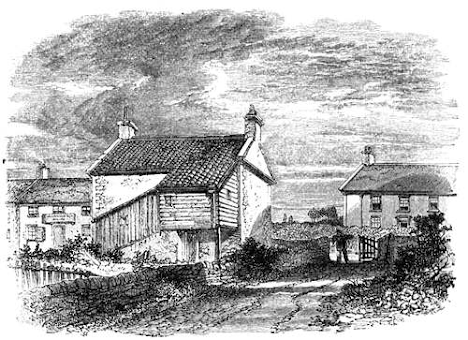
The only known surviving image of Rutter’s School (centre), by R.P.Leitch, with Front Street running left to right behind the open gate. The ‘old’ Ship Inn can be seen across the road in the background.

The institution was the official parish school, and was run by one Thomas Rutter, parish clerk of the late eighteenth and early nineteenth century. It offered a fairly basic level of education, if reports are to be believed; yet the school was popular among the aspiring middle classes – and helped two very prominent individuals on their way to undisputed greatness.

Thomas Addison was born in 1793 in a house adjoining The Black Bull Inn – a stone’s throw or two away on the opposite side of the road from the school. The property doubled as the workplace of his parents, Joseph and Sarah, who were grocers and flour dealers. Despite a scanty education at Rutter’s, Addison went on to study at Newcastle’s Royal Grammar School, before moving on to Edinburgh University’s Medical School. After moving to London, he worked at the famous Lock Hospital (venereal diseases), and eventually found himself working as a physician at Guy’s Hospital where he rose through the ranks, gaining an increasingly brilliant reputation in the field of skin diseases. You probably know where this is going by now, so, yes, he was the man who first described the condition which later came to be known as Addison’s Disease in 1855. He was a regular sufferer of depression, and committed suicide in 1860; after which he was, somewhat curiously, buried in the churchyard of Lanercost Priory in Cumberland.

Rutter’s School’s other famous pupil was Robert Stephenson, son of George. Robert had been born in Willington Quay in 1803, and was living with his widowed father in Dial Cottage, West Moor, when he was in attendance at Rutter’s (to which he would commute on a donkey). He was later to say, whilst pointing to the humble red-tiled house by the roadside at Benton: “You see that house – that was Rutter’s, where I learned my A B C, and made a beginning of my school learning.” His father, George, scrimped and scraped to further his son’s learning, next sending him to the famous John Bruce Academy on Percy Street, Newcastle. And, as we know, it all paid off rather nicely.

[this article is taken from my book Newcastle-upon-Tyne: Tales from the Suburbs - see left-hand column for further details]


Tuesday, 31 May 2022

Newcastle & Newspapers

I have this loose idea floating around in my head that some day I'd like to write a book about Newcastle's history from the point of view of both my own and my past family's perspective. You know, a sort of exploration of the corners of the town/city which have a 'connection' with my ancestors and I. I have been looking into my family tree, on and off, for more than 30 years, but have never properly focused in on my links with the city in which I was born in 1964. Genealogical research on one's family is never ever really 'complete', but sooner or later I'm gonna have to bite the bullet and get my Newcastle connections well and truly sorted.

The roots of my mam's direct line (the Lothians/Lowthians) go back to Cumberland. I think there is a distant cousinship to Isaac Lowthian Bell, the great Tyneside industrialist, and his granddaughter, the explorer Gertrude Bell - whose line also hails from Cumberland. Anyway, my mam's family arrived in Newcastle c.1850 and, well, here we still are today. My dad's line (the Southwicks) arrived on Tyneside c.1870 from the Black Country - but married into other, maternal lines which have a presence in Newcastle going back to at least the 1820s. Across the two sides of the family I have ancestral interests in central Newcastle, the Blandford Street area, the old streets around 'Eldon Garden' off Percy Street, Benwell, Denton Burn and some others I can't recall right now. And if I get myself sorted, there'll be plenty of other places to investigate, too!

Now I'm not going to bore you with the fine detail, but there are tons of problems with my paternal line in particular. My grandfather, Walter Southwick, and his father (also Walter), have proved to be pretty elusive. They just seem to have had a knack for avoiding officialdom and kept wandering around. Walter Jr is especially troublesome, research-wise. His birth in 1906 (Hanover Square, Newcastle) was registered under his mother's surname, which took some finding; he is not immediately traceable on the 1911 and 1921 censuses; then he gets married in London and fathers my dad in 1936; and, at 48yrs of age, he dies in Newcastle in 1954. I didn't even have a photo of him until quite recently.

In the past few months, though, things have began to appear out of the mist. I found a newspaper report that indicates that a "W.Southwick" enrolled in the army in the 1920s, was posted to the West Indies, then promptly deserted. I'm pretty confident this IS my Walter, but can't be 100% sure yet. I will have to apply for the chap's army records, I guess.

Then, just yesterday, I saw that FindMyPast, the genealogy research company, were offering free access to all their newspaper records until 10am on Monday 6th June 2022. So I thought I'd have a look to see if my grandfather, Walter Southwick (Jr), popped up anywhere.

There was no reference to the fall-out following his supposed army desertion, but, amazingly, I fell upon three other mentions of his law-breaking. In March 1931, he was caught pinching a large boxful of items from the Palladium cinema in Newcastle's Groat Market (it used to stand where Thomson House was later built). He was apprehended by a waiting PC whilst lowering the goods, then himself, from a rear window. The stolen goods included clothes, towels, cutlery - and basically anything he could get his hands on during the burglary.

He was hauled before 'The Bench', found guilty, but in view of the man's run of bad luck they decided to take a sympathetic view and remanded him in custody for arrangements to be made for some help to be obtained for him through the Church Army.

OK, then, so that's another part of Newcastle I've now got an interest in: The Palladium in the Groat Market!

In November of the same year (1931), he popped up as a "jobbing gardener" at Pontefract Police Court, accused of pinching brushes and other cleaning materials to the value of approximately £3 from Upton Council School. He was also found to have a "football bladder" in his pocket. He got six months' hard labour. And furthermore, it was added that he had been convicted several times previously at Newcastle. I guess I've got some more Toon research to do, then!

No wonder the man is hard to find. In the Pontefract case he supposedly was of "no fixed abode"; but I know that he spent some time in London in the 1930s (where my dad was born), including, probably, the war years. But then, in October 1949, he mysteriously appears as a "43-year-old labourer of Duke Street, Newcastle" in Penrith Court, after stealing a bicycle from a farm in Plumpton, Cumberland. It seems that he nicked the bike, rode to Greenhead and was arrested there. What was he up to, I wonder?

There were a couple of other suspect incidents, too, involving Walter Sr (his dad), and even a possible street fight in which his granddad, Joseph, was embroiled in Darlington in 1868. And all of this extra detail from plain old newspaper reports - brilliant!

So do have a look for your ancestors in the freely-available FindMyPast newspaper database before the offer expires on the morning of 6th June. You never known what you might find.