Fragments of the Town's Past ... and of the North-East, too - with all profits from the sale of (most of) my books being donated to the Great North Children's Hospital.
Tuesday, 9 June 2026
Charlton Heston's Geordie Roots
Saturday, 27 December 2025
The Lane That Moved: the Story of Friday Fields Lane
Nothing much, as it turned out. And I was none the wiser as regards an explanation for the lane’s unusual moniker. When I got back home I did what any self-respecting amateur historian would do and had a look at a few books and scoured the internet for an explanation. There wasn’t a great deal to be found, but I’ll give you what I have.
In the days before the suburban sprawl arrived, there used to be a wee farmstead by the name of Friday Farm, situated roughly on the junction of present-day Haldane and Otterburn Terraces (being a good deal to the south of our mysterious lane). I don’t know how or why it was called thus (I mean, the name of the farmstead is a bit unusual), but at least we have a clue as to the source of our odd-sounding byway to the north. And, as was the norm back in those days of rural Jesmond, the fields around and about were given names, too. In this area they were collectively known as the ‘Friday Fields’, with specific examples being ‘Little Short Friday’, ‘Great Friday’ and, tellingly, ‘Long Friday’. The latter of those expanses of open farmland was a bit of a funny shape – elongated, like a road almost – and could well be the root of the ‘Friday Fields Lane’ epithet. We can perhaps imagine that it became a pathway of sorts, through and between the neighbouring fields, arrowing northward towards what would eventually become Jesmond Dene Road. Or maybe not. It might have been nothing to do with the handily-named field, but instead just been a nearby and long-established ‘public right of way’, as we now call them.
In time, the rough byway morphed into a lane proper, essentially becoming the ‘lane to Friday Fields’ at its southern extremity (running along, roughly, present-day North Jesmond Avenue, St.George’s Terrace and Tankerville Terrace). But as the changing landscape and various realignments settled down into the suburban map we know today, the long lane became severely truncated, with only the northern tip remaining.
The course of this much-shortened Victorian ‘Friday Fields Lane’ was not, however, in its current location, but rather a little to the east – essentially on the other side of North Jesmond House/La Sagesse School. For, on all of the OS maps up until the immediate post-WWII period, the lane in question is clearly shown on the other side of the aforementioned institution. The switch seems to have been made at some point in the 1950s or early ’60s, possibly at a point when the school/convent was properly establishing itself and wanted a little re-jig of the surrounding thoroughfares.
And so Friday Fields Lane was moved a few dozen yards to the west to its present location. It no longer runs along its former course, nor does it lead or extend to anywhere near its original destination of Friday Fields – now some one and a bit miles to the south (and currently on and around the site of the Newcastle High School for Girls, Senior School). It’s a wonder it has retained its old name at all.
Ordnance Survey (1951, surveyed 1949)
Reproduced with the permission of the National Library of Scotland
And that’s about it, as far I can tell. There are a couple of other little tales surrounding the old thoroughfare which I might as well throw in for good measure. It was known locally as Lovers’ Walk for some time, as these pretty little pedestrian lanes so often are; and historian Steve Ellwood mentioned online some time ago an interesting little snippet that he picked up from another local historian and city guide, Alan Morgan, that “a pedestrian subway was built in the 1800’s by Charles Mitchell to accommodate Friday Fields Lane which lay in the way of the carriageway drive to Jesmond Towers. According to Alan it remains in place, albeit under the present road, Towers Avenue”. Could this mysterious underpass, Steve suggests, be the first pedestrian subway in Newcastle?
Oh, no, not another historical conundrum….
Alan Morgan – with his Jesmond: From Mines to Mansions being a particularly good starting point on the history of the suburb;
Steve Ellwood – for his excellent general commentary (both online and off-) on the local history of Newcastle and its suburbs, often via the SkyscraperCity Forums at www.skyscrapercity.com ;
The helpful and lengthy article at https://hightimes.churchhigh.me.uk/background/ ;
And the always excellent online resource that is https://maps.nls.uk/os/ .
Saturday, 10 February 2024
Dr Ruth Nicholson, FRCOG: Medical Pioneer
In August 2021 a commemorative plaque was unveiled at 32 Kenilworth Road, Elswick, in honour of Dr Ruth Nicholson. The soon-to-be prominent surgeon was born in this modest terraced house on 2nd December 1884, being the eldest child of Margaret and the Rev.Ralph Nicholson, a local Church of England cleric. Supposedly, she chose to study medicine after her father took her to see an exhibition in Newcastle on the subject of medical missionary work. Her mother, too, was quite determined to secure for all her children a sound and independent future.
This ground-breaking individual was educated locally, first at Newcastle Church High School in Jesmond, then at the city’s College of Medicine. She was the only female graduate from the institution in 1909. Her medical career began in a local dispensary in Newcastle, before she moved on to Edinburgh, followed by a stint at a mission hospital in Gaza.
By the outbreak of World War I she had gathered a fair bit of varied surgical experience, but her gender prevented her from working in British military hospitals. So instead she joined an all-female unit backed by the French government. This organisation, which was run by the Scottish Women’s Hospital (founded by Scotswoman Elsie Inglis, with whom she had worked in Edinburgh) was based at Royaumont Abbey, north of Paris. For the entirety of the war Nicholson worked there as a surgeon, operating on allied casualties, and often working with barely any sleep for days on end (indeed, the number of beds at the hospital peaked at 600). Her considerable efforts earned her the Croix de Guerre and the Médaille d’Honneur des Épidémies.
Post-war she worked for a time as a GP in Birkenhead, then threw herself into obstetrics and gynaecology, eventually becoming a founder member of the Royal College of Obstetricians and Gynaecologists in 1929 (and thereafter a fellow in 1931 – hence the letters after her name). A prominent position at the University of Liverpool came her way in 1930, and she took on consultancy roles, whilst at the same time running her own private practice. In time, Nicholson rose to become the very first female president of the North of England Obstetrical and Gynaecological Society.
After a long and successful career, Dr Ruth Nicholson died in Exeter on 2nd July 1963, aged 78.
[article taken from Newcastle-upon-Tyne: Tales from the Suburbs - see left-hand column for further details about this book]
Thursday, 27 July 2023
Jesmond ... as an Army Testing Ground!
If the British Army learnt anything from the Crimean campaign of 1853-56, it was that they needed major upgrades in the artillery department. The field guns were too difficult to manoeuvre; and lighter, more mobile units were required. William Armstrong, with his nice new engineering works at Elswick, decided that it’d be fun to get involved in the post-war clamour for new weaponry – so he became involved in gun development in a rather big way. To cut a long story short, Armstrong developed and manufactured a highly efficient and effective breech-loading field gun (which fired shells rather than balls) that everyone was really rather pleased with. He ended up being knighted for his work in 1859, after he’d surrendered the patent for the gun to the British government, rather than profiting personally from its design.
At the time Armstrong lived in his mansion, Jesmond Dean, overlooking Jesmond Vale. And, astonishing as it may sound to us today, during the period in which he was perfecting his new invention he would regularly conduct field trials near his home. In a letter to the famous Isambard Kingdom Brunel he stated: “Firing practice takes place between the peaceful hours of 3 and 5 when people are in bed and out of harm’s way. The gun is placed in the field where the dungheap was and I fire across the valley against a vertical bank at a distance of 435 yards.” Indeed, experimental guns were constantly being tested in all sorts of places, not just Jesmond Vale. The moorlands around Allenheads were regularly peppered with shell-fire, as were stretches of the coastline. On many occasions it must have seemed to unsuspecting locals that some foreign invasion was afoot.
What residents there were who were living in and around Jesmond at the time may, however, have been used to Armstrong’s earth-shattering shenanigans. As early as 1854, our man had been asked by the War Office to design underwater mines to help dislodge the wrecks of Russian ships that were blocking the entrance to Sebastopol Harbour. Armstrong came up with a device consisting of a wrought-iron cylinder loaded with guncotton (a kind of propellant), which he tested in the fields of Jesmond in front of an invited audience. “It was a very pleasant function and greatly enjoyed by all the guests,” he boasted, continuing, “the mines, planted in different parts of the field, exploded in the most exhilarating manner, and after tea had been served out, the party separated, delighted with the afternoon’s entertainment.” As it happened, this particular idea was never taken forward by the authorities.
Monday, 30 January 2023
Cricket in Newcastle: A Brief History
By around 1800, cricket looked pretty much as we know it today: straight bat (instead of curved), three stumps instead of two, and match statistics were being properly recorded. It was especially popular down south, with the MCC, for example, being formed in 1787. Up here, it took a little longer to infiltrate society’s leisure time; though town historian Mackenzie, writing in 1827, says that “one or two cricket clubs” were playing on the Town Moor.
Before the formation of a national ‘England’ team, the famous ‘All England XI’, formed in 1846, toured the country widely, popularising the game. Between 1847 and 1850, this pioneering team played several matches across the North-East, including Newcastle. They were usually three-day affairs, and were a mixture of amateurs and professionals, the sides often being of unequal numbers to even up the match. In those early years, the All England team won all their games in the region, bar a match played at Newcastle in 1847 against the Northumberland Cricket Club, which ended in a draw (the local side used 20 players including a couple of Yorkshire pros and a handful of leading Scots). By this time, the Northumberland Cricket Club itself had existed for a while (it reportedly played its first match on the Town Moor on 11th July 1838) and had around 150 members. Come the late 1840s – and that prestige match against the All England XI – this club had what would be the only ever ‘real’ cricket ground in the town centre, immediately to the east of the present-day Northumberland Baths (which themselves had been built in 1839). The attractive site was known as the Bath Road Ground – being named after the nearby thoroughfare, which is now known as Northumberland Road – and overlooked the now filled-in Pandon Dene. It was thrown open to the public on match days, and attracted young men in their hundreds. Just to liven things up, they also had their own band … which even exercised their talents during play. Talking of bands, there was also a shadowy cricketing outfit known as ‘Newcastle Clayton’, of which little is known, who also played along to the music!
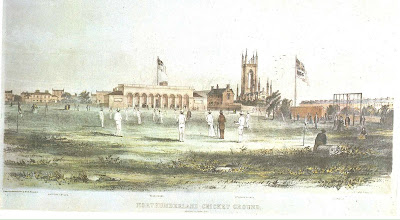
In time, this ground was swallowed by urban sprawl. In 1881, the land was sold to make way for several notable institutions, including Dame Allan’s School. The club remained in being, but moved around a bit, including playing at Heaton, until it was dissolved in 1895. It was almost instantly reformed, and in 1896-7 set up afresh on Osborne Avenue, Jesmond, taking over an existing ground – and where it remains to this day. From 1877 until 1887, an outfit called ‘Newcastle Cricket Club’ played on a ground subsequently occupied (from 1888) by the Fleming Memorial Hospital in South Jesmond, just off the Great North Road (and not too far from the town/city centre). Many minor clubs continued on the Town Moor, and many more teams represented churches and the like.
Gosforth seems to have been a centre of early sporting activity. Organised cricket began there in the mid 1860s, though South Northumberland Cricket Club emerged as the main force in the early 1880s. ‘South North’, as they came to be known, even had a pro bowler at an early stage and went on to become (and still are) quite a force in the sport. The Town Moor and various other open spaces scattered among the suburbs hosted clubs such as ‘The Mechanics’, ‘The Claremont’, ‘The Newcastle’, ‘The Press’, etc.; and further afield in places such as Benwell, the sport found what often proved to be, eventually, well-established niches in people’s lives. It is worth remembering, too, that Newcastle United FC’s roots lie in South Byker and the ambitions of Stanley Cricket Club, who founded Newcastle East End FC in 1881 (and Newcastle West End FC were also formed by a cricket club a year later, namely West End Junior CC, originally known as the Crown CC).
By 1900, there were around a dozen active Newcastle clubs of substance – all of which, by this time, though, were scattered throughout the suburbs.
[main source: Newcastle-upon-Tyne: Its Growth & Achievement by S.Middlebrook (1950)]
---o---
Perhaps the Bath Road Ground’s most noted cricketing fixture was that which spanned 1st-3rd July 1880 between an “18 of Newcastle” (or “Newcastle & District”) and The Australians. It was not classified as a First Class match, but was one of 40+ minor fixtures of the visitors’ summer tour. The three-day match took place amidst dull and occasionally showery conditions, on a “fast and true wicket” in front of what was considered to have been a poor attendance. Newcastle batted first, the elongated batting line-up making 115 (Watson top-scoring with 31, and famous Aussie, Fred ‘The Demon’ Spofforth, taking most of the wickets). The Australians replied with 222, including the tour’s first individual century: Murdoch scoring 117. In their second innings, Newcastle managed a highly respectable 202, leaving the visitors a modest 90-odd to win … but the weather hindered progress on the third and final day, leaving The Australians on 48 for 4. Who knows, we might have won … though we did have more players!
[source: various newspapers of the day]
[ This article first appeared in my book Newcastle-upon-Tyne: Fragments of the Past, Vol.2 (see left-hand column), and I have been inspired to reproduce it by the efforts of Kieran Carter's excellent North East Heritage Library's 'Sports Archive' ]

_page-0001.jpg)
