Wednesday, 28 May 2025

Preston Pele Tower


On our way back from our Farne Islands boat trip the other day (see previous post), we just had enough time to call in at a place which I'd passed loads of times without giving it a second thought. It's Preston Pele Tower, about a mile south of Chathill, Northumberland. Though there is no fee to pay, you are politely requested to drop £4 into the honesty box.


It's an odd-looking affair, its slenderness resulting from its partial demolition at some point in the past - probably after the union of the crowns in 1603. It is supposed to have four corner turrets, giving the appearance of a sort of mini-castle, but all that remains are the two southern towers. It is essentially half a pele tower.

It was built in the 1390s, at a time when the border region was ablaze with Anglo-Scottish rivalry - to say nothing of the rapidly accelerating uncertainty of the Border Reiver era. Families with something to protect felt it necessary to build such fortifications - though I'm not sure which clan was responsible for this splendid fourteenth century effort. It does, though, bear the same masons' marks as those found at Warkworth Castle.


Above can be seen the tower's clock face (actually, in has one on each side of the tower), added by owner, Henry Baker Cresswell, in 1864 during renovation work to the structure.

Upon arrival - and assuming there are no 'functions' taking place at the location - there is nothing and nobody to stop the casual visitor from entering and having a wander around the internal bits. The rooms are spread out over several floors and are tiny, but have been 'done out' in typical olde worlde style, as you can see from the pics below (please excuse my wife getting in the way):


Here are the workings of the clock:


And here is the scene from the top storey:


(yes, that's Angie again, I'm afraid, who appears to be vomiting over the parapet)

And, of course, the obligatory Information Panels (click on images to enlarge):


The light was dying fast on our brief visit, so my apologies for the iffy photos. As I hinted at earlier, the site hosts events from time to time, so unless you're 'just passing' and fancy calling in on spec then it's best to give them a ring first. Website here.

Monday, 19 May 2025

Trip to Inner Farne

For the first time in my lifetime's worth of endless North-East wanderings I actually set foot on one of the Farne Islands the other day. Thanks to Billy Shiel's Boat Trips, my wife, my son, a friend and I set out for the little archipelago off the coast of North Northumberland on what was a quite beautiful spring day. My wife was looking for puffins, and I was looking for a bit of history. We got plenty of both!

I'll keep it brief - I mean, the pics speak for themselves - but will fill you in with a bit of detail. And as for the photos, well, it wasn't easy what with the rolling sea and what have you (as well as my rather old mobile phone). Anyway, I'll give you what I have. Remember to click on the images to enlarge.

We made for the Outer Farnes first, where we first fell upon the Old Brownsman Island Lighthouse & Keeper's Cottage:


Not allowed to land there, though, so we swept around to have a gander at Longstone Island and its lighthouse, made famous by the Darling family and that rescue:


After swiveling around the other islands for a good while, taking in the abundant birdlife and the seals (no Orcas, though!), we headed back towards the island of Inner Farne:


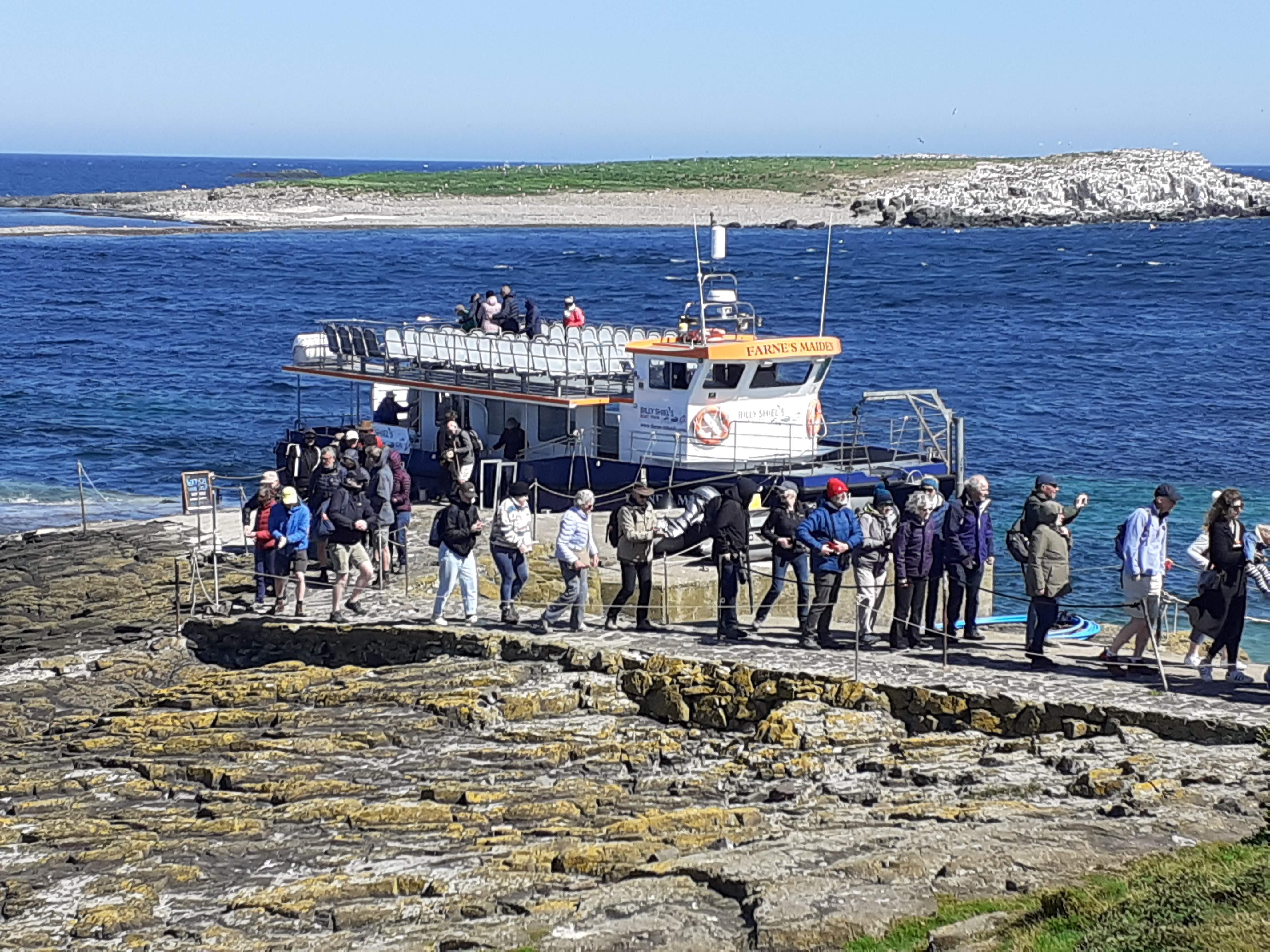
... Where we alighted:


We were thankfully spared from the infamous bird attacks (maybe it was the wrong time of year), but there were certainly plenty of the little creatures around. Firstly, though, we headed for a brief talk in the visitor centre (lots of information boards to take in), then headed across the way to St.Cuthbert's Chapel:


No, it's not the original chapel of Cuthbert/Aidan, with this incarnation dating to the 13th and/or 14th centuries.


And then there's Inner Farne Tower, aka Prior Castell's Tower. Originally built in the late 15th century as accommodation for monks, it has since served as a military barracks, a beacon, a lighthouse, and currently offers a home to National Trust rangers.


There's a circuit of the island laid out for visitors, so it was off across to the lighthouse next...


... Whilst peeping over the cliff edge to admire the birdlife (razorbill nearest to camera):


And, of course, lots and lots of puffins:


And Arctic terns, who like to nest on sand and gravel, apparently;


A nice view over to the mainland, and Bamburgh Castle:


And thence back full circle to the tower (complete with more puffins):


And that was about it. Three hours in total, and well worth the effort. It is a bit pricey, mind you - and you've got to hand over cash to the National Trust at the harbour, too, to get a landing pass for Inner Farne. Fortunately, we were able to pull a few strings and get a free trip thanks to my son's partner being related to the Billy Shiel family. Nice one.

Finally, I happened to look at my phone on the way back where I noted my exact position on Google Maps (gulp!):


What a cracking day. And I called in somewhere else that was rather interesting on the way back home, too. More on that next time...

Monday, 5 May 2025

Newcastle 900 Celebrations (1980)

OK, then, here it is: my latest purchase from eBay. Please, though, don't tell the wife.

(click image to enlarge)


You'd have to be a certain age to remember it, of course; but in 1980 the city of Newcastle-upon-Tyne celebrated its 900th anniversary since its founding by the Normans. The 900-year-old thing is not strictly true, though, as we know that there were previous settlements on the spot going back to at least the Roman period. But it has been known as 'Newcastle' since 1080 when the, er, 'New Castle' was built.

I was a disinterested teenager at the time, so I recall almost nothing of the occasion. It seems, however, to have been quite an event. For one thing, I have acquired, at some point, the following book...


... And there were plenty of other items of tat on offer too, of course, including loads of other publications and memorabilia - much of which, dare I say, may still be kicking about in your loft. Anyway. there is a good deal to found online regarding the 'event', with the best place to start being the excellent Skyscraper City page on the topic

There are also a few nice pics here.

And a little reminder that the 'Newcastle 1,000' celebrations are fast approaching, too. Only 55 years to go.

Friday, 25 April 2025

The Strange Case of Rachel Parsons


Those of you who know even a little bit about the history of the North-East will have heard of Charles Algernon Parsons, the remarkable mechanical engineer and inventor responsible for the early development of the steam turbine. He wasn't a North-Easterner by birth, but spent most of his days based in and around Newcastle and Gateshead where he would eventually earn for himself a world famous reputation in his field.

He and his wife, Katharine, had two children, a son and a daughter. Algernon George "Tommy" Parsons was killed in action in 1918. Their daughter, though, Rachel Mary Parsons, followed her father into science and industry - and to startling effect.

However, following the death of her brother in 1918, she seems to have gone into a slow and steady mental decline. It was only very gradual - and she continued to have astonishing success along the way - but her condition seemed to accelerate after she inherited her parents fortune in the early 1930s. She never married, nor did she have any children, and descended eventually into a sad and lonely existence in her various properties.

And then, in 1956, she was murdered. The story is extraordinary, and I would urge you to read the following articles in order. Firstly, have a look at her Wikipedia entry.

Then check out a comprehensive account of her death.

And there's a little addendum here.

How strange. And what a sad end to a truly stupendous family legacy.

Wednesday, 16 April 2025

Demise of J.G.Windows


On 29th November 2024 one of Newcastle’s best known stores closed after 116 years of trading. JG Windows Ltd, the city’s original music store, finally fell to the march of time and the relentless online competition. It was a long and happy existence, and the store’s loss is a significant watershed moment for lovers of the high street retail world. It went into formal liquidation on 12th December.

No matter how old you are, the Windows outlet in the beautiful environs of the city’s Central Arcade was a mainstay of your life - correctly describing itself in its closure notice as “a cornerstone of the region’s musical heritage.” The shop sold not only music in all its many and varied forms - a large percentage of it ‘niche’ or ‘specialist’ - but also musical instruments, sheet music and all manner of related electronic devices and equipment. There really was no other place quite like it.

(click on image to enlarge)

Founded by the Windows family in 1908 in the almost brand new Central Arcade, the business changed hands in 2006; and from 2020 J.G.Windows also ran a music academy. Its other two outlets, in Darlington and the MetroCentre, closed in 2018 and 2022, respectively. The demise of the company’s mother branch in Newcastle was a slow-burner, with the business being put up for sale in 2023, but despite strenuous efforts a buyer could not be found. The closure meant redundancy for the concern’s 17 employees.


In the aftermath of the closure, local stars of the music scene, such as Neil Tennant, Mark Knopfler, and members of Lindisfarne, expressed their sorrow at the sad turn of events.

Goodbye, old friend.


Saturday, 5 April 2025

Souter: the Lighthouse With the Wrong Name


The North-East of England is famous for countless British and world 'firsts'; and the stunning coastal landmark that is Souter Lighthouse, betwixt the mouths of the Tyne and the Wear, represents another such effort. For, despite being out of action since 1988, the gleaming specimen that we still see today, was the very first lighthouse in Britain - and most likely, we think, the world - to be designed and built specifically to use electric power. When it was switched on in 1871 it was, therefore, the most advanced structure of its type.

Previously, operators of the South Foreland Lighthouse near Dover had fiddled around with electrical power during 1858-62, but this effort was an adaptation of an existing building. Souter was purpose-built for electricity from its inception - and constructed after a good deal of research following on from that earlier South Foreland experiment.

Strangely, the lighthouse is, strictly speaking, incorrectly named. For the structure sits on Lizard Point, with Souter Point being about a mile to the south. After much humming and hawing, Lizard Point was considered a better spot than Souter Point, so it was erected a little further north than originally intended. But as there was already a 'Lizard Lighthouse' down in Cornwall, they decided to stick with the geographically-incorrect moniker to avoid confusion. The light itself was generated by a carbon arc lamp, and was first lit to great acclaim on 11th January 1871. 

This particular stretch of coastline had an appalling record when it came to shipwrecks, with dangerous reefs and rocky outcrops abounding; so the new warning beacon was considered an essential addition to the coastal scene. The light, which was generated by two magneto-electric generators, had a range of 26 miles, and was supplemented by a huge double-foghorn - which itself was powered by the same source. Then, in 1891, the tower gained its distinctive broad red band!

Obviously, the lighthouse was upgraded from time to time, including being converted to oil-power in 1914 - eventually reverting to electric (this time via mains electricity) in 1952. Trinity House, who were of course responsible for Souter Lighthouse's construction back in 1871, eventually decommissioned its own creation in 1988. Perhaps unusually, it was never automated, so the building happily retains much of its old internal workings.

The site is now run by the National Trust and is open to visitors. It is blessed with a cafe and small second-hand bookshop ... and even has a couple of holiday lets!


Saturday, 29 March 2025

NUFC Cup Celebrations

As we welcome Newcastle United's players home with the League Cup today, I thought I'd scan YouTube to see if I could find footage of our most recent cup homecomings. Now, as we're talking about 1955 (for a domestic trophy) and 1969 for ANY trophy, well, there isn't much available ... and nothing in colour that I could find! Anyway, firstly, here are a couple of short films from 1955 and that famous F.A.Cup win:


And this is the best I could do with the 'homecoming':


As for the Inter-Cities Fairs Cup of 1969, the following gives a nice overview of the occasion, including some limited 'homecoming' footage:


Obviously, more extensive match footage of both finals can easily be found on YouTube, but I thought I'd keep it brief as I'm sure you're keen to get yourself doon the toon to welcome the boys of 2025 home. I'll be in the crowd somewhere!