Sunday, 29 June 2025

The Tyne's Roman Shrines

If you ever find yourself wandering amidst the schoolkids at Newcastle's Hancock Museum, please be sure to check out the following collection of suitably coloured Roman altars that can be found in the Hadrian's Wall gallery:

(click on image to enlarge)

And have an especially close look at the left-hand pair, dedicated to the gods Neptune and Oceanus, as these are particularly significant:


You mustn't worry, though, for they haven't actually been daubed with modern-day masonry paint. And whilst you're standing there you may well wonder for some confused moments how the special effect has been, well, effected. It's all a trick of the light - see here for the official story. And the nearby info panel puts you in the picture, too:


As for the two altars to the left, well, they were dredged from the bed of the River Tyne in 1875 (Neptune) and 1903 (Oceanus), respectively, at the spot now occupied by the Swing Bridge. It was here that the old Roman Bridge of Pons Aelius spanned the river, and the altars would most probably have adorned the structure (or possibly formed the centre piece of a bridgehead shrine)  - and may even have been deliberately cast into the river at some point in an act of dedication. Neptune and Oceanus were, of course, water gods, and their placement upon or near the Roman bridge would be perfectly appropriate. 

Both stones bear a dedication to their respective god and the inscription "the Sixth Victorious Legion Loyal and Faithful (made this)". The 6th Legion was active in Britain from 122 AD to the end of the Roman occupation, so there's a good chance they were made at the time of Hadrian and the construction of his famous Wall.

Brilliant effort by the Hancock, this. It's the sort of thing that makes museums genuinely interesting!

Wednesday, 18 June 2025

Newcastle's Alternative High Level Bridge


The Martin brothers were a well-known gaggle of siblings who hailed from the Haydon Bridge area of Northumberland in the late eighteenth century. The most famous of the litter was John, who became a very famous artist. Though brilliant, John was a little eccentric; but that was nothing compared to brother Jonathan, who is best remembered for torching York Minster in 1829.

The sanest of the bunch was Richard, who spent many years in the military; and then there was a sister, Anne, of whom we know virtually nothing – as well as many more brothers and sisters who died in infancy.

However, the oldest of the lot, William, was as equally unbalanced as arsonist Jonathan. Born in Bardon Mill in 1772, he spent a decade in the Northumberland Militia, before becoming an inventor.

Initially, he seemed to have rather a lot of good ideas, winning awards for some of his schemes and patents; but his particular take on the non-existence of gravity and his theories on perpetual motion machines proved (obviously) to be misplaced. As the 1820s and ’30s progressed he became ever more famous for his peculiar pronouncements (his ‘Anti-Newtonian’ campaign being particularly loopy). He presented himself as something of an ‘alternative’ philosopher, proposing all sorts of weird and wonderful items, ideas and concepts, progressively distancing himself from reality in the process.

However, one of his more sensible ideas was for a high-level bridge over the Tyne at Newcastle, put forward many years before Robert Stephenson’s version was actually built – and he even published a pamphlet illustrating the design, and claimed later that Stephenson had stolen his idea. These sparse facts, and the image of the said river crossing as shown above is all that seems to have survived of this remarkable passage of history.


William Martin was once described by a contemporary as “perfectly cracked, but harmless.” He was a genuine, yet brilliant, eccentric, who lived on just the wrong side of madness. He died at his brother John’s house in Chelsea in 1851 – a little over a year after the real High Level Bridge was actually completed. And I must say that the final design does look rather similar to William Martin’s….

[this article is taken from my book Newcastle-upon-Tyne: Fragments of the Past, vol.3. See left-hand column for link to examine the tome on Amazon]


Monday, 9 June 2025

Newcastle's Historical Pageant of 1931

When I bought this 'event programme' on eBay, I was, quite frankly, expecting a bit more to it. Anyway, I've got it now, so I'm going to let you have a look, too. It concerns a week-long jolly on Leazes Park and Exhibition Park, Newcastle, in the summer of 1931 entitled 'The Historical Pageant of Newcastle and the North and Empire Fair'. The brochure is tiny - about 3 inches by 5 inches - and here it is in its entirety: 


(click on images to enlarge)


Curious to see what all the fuss was about, I found a fifteen minute film about the event here. There is also a great deal of information to be found here, too. These sort of affairs were quite popular in the 1930s, apparently - though if the little film is anything to go by it doesn't seem terribly exciting. Perhaps folk were easily pleased back in those days. Or maybe the film coverage doesn't do it justice!

Quite interesting, all the same.

Wednesday, 28 May 2025

Preston Pele Tower


On our way back from our Farne Islands boat trip the other day (see previous post), we just had enough time to call in at a place which I'd passed loads of times without giving it a second thought. It's Preston Pele Tower, about a mile south of Chathill, Northumberland. Though there is no fee to pay, you are politely requested to drop £4 into the honesty box.


It's an odd-looking affair, its slenderness resulting from its partial demolition at some point in the past - probably after the union of the crowns in 1603. It is supposed to have four corner turrets, giving the appearance of a sort of mini-castle, but all that remains are the two southern towers. It is essentially half a pele tower.

It was built in the 1390s, at a time when the border region was ablaze with Anglo-Scottish rivalry - to say nothing of the rapidly accelerating uncertainty of the Border Reiver era. Families with something to protect felt it necessary to build such fortifications - though I'm not sure which clan was responsible for this splendid fourteenth century effort. It does, though, bear the same masons' marks as those found at Warkworth Castle.


Above can be seen the tower's clock face (actually, in has one on each side of the tower), added by owner, Henry Baker Cresswell, in 1864 during renovation work to the structure.

Upon arrival - and assuming there are no 'functions' taking place at the location - there is nothing and nobody to stop the casual visitor from entering and having a wander around the internal bits. The rooms are spread out over several floors and are tiny, but have been 'done out' in typical olde worlde style, as you can see from the pics below (please excuse my wife getting in the way):


Here are the workings of the clock:


And here is the scene from the top storey:


(yes, that's Angie again, I'm afraid, who appears to be vomiting over the parapet)

And, of course, the obligatory Information Panels (click on images to enlarge):


The light was dying fast on our brief visit, so my apologies for the iffy photos. As I hinted at earlier, the site hosts events from time to time, so unless you're 'just passing' and fancy calling in on spec then it's best to give them a ring first. Website here.

Monday, 19 May 2025

Trip to Inner Farne

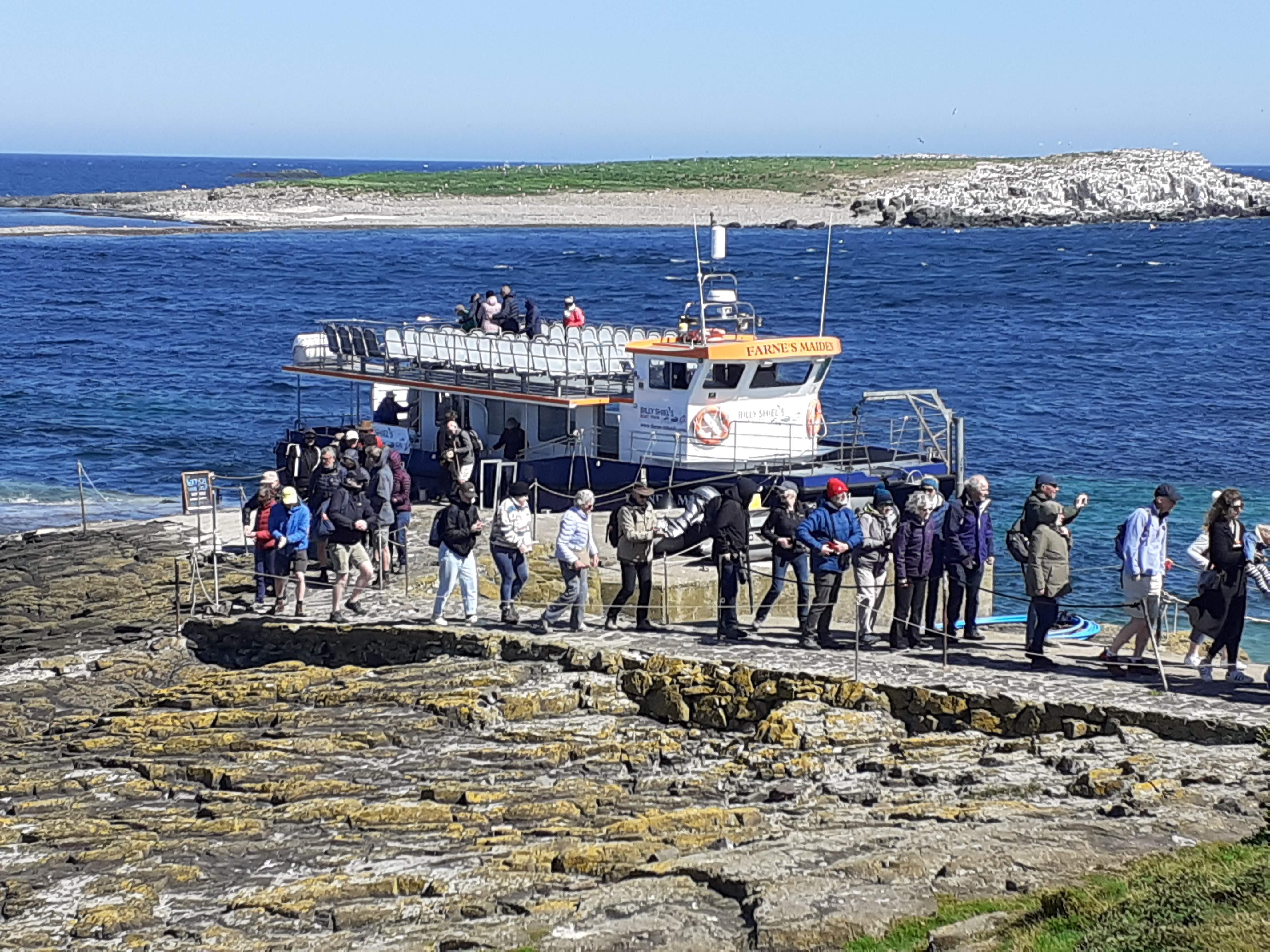
For the first time in my lifetime's worth of endless North-East wanderings I actually set foot on one of the Farne Islands the other day. Thanks to Billy Shiel's Boat Trips, my wife, my son, a friend and I set out for the little archipelago off the coast of North Northumberland on what was a quite beautiful spring day. My wife was looking for puffins, and I was looking for a bit of history. We got plenty of both!

I'll keep it brief - I mean, the pics speak for themselves - but will fill you in with a bit of detail. And as for the photos, well, it wasn't easy what with the rolling sea and what have you (as well as my rather old mobile phone). Anyway, I'll give you what I have. Remember to click on the images to enlarge.

We made for the Outer Farnes first, where we first fell upon the Old Brownsman Island Lighthouse & Keeper's Cottage:


Not allowed to land there, though, so we swept around to have a gander at Longstone Island and its lighthouse, made famous by the Darling family and that rescue:


After swiveling around the other islands for a good while, taking in the abundant birdlife and the seals (no Orcas, though!), we headed back towards the island of Inner Farne:


... Where we alighted:


We were thankfully spared from the infamous bird attacks (maybe it was the wrong time of year), but there were certainly plenty of the little creatures around. Firstly, though, we headed for a brief talk in the visitor centre (lots of information boards to take in), then headed across the way to St.Cuthbert's Chapel:


No, it's not the original chapel of Cuthbert/Aidan, with this incarnation dating to the 13th and/or 14th centuries.


And then there's Inner Farne Tower, aka Prior Castell's Tower. Originally built in the late 15th century as accommodation for monks, it has since served as a military barracks, a beacon, a lighthouse, and currently offers a home to National Trust rangers.


There's a circuit of the island laid out for visitors, so it was off across to the lighthouse next...


... Whilst peeping over the cliff edge to admire the birdlife (razorbill nearest to camera):


And, of course, lots and lots of puffins:


And Arctic terns, who like to nest on sand and gravel, apparently;


A nice view over to the mainland, and Bamburgh Castle:


And thence back full circle to the tower (complete with more puffins):


And that was about it. Three hours in total, and well worth the effort. It is a bit pricey, mind you - and you've got to hand over cash to the National Trust at the harbour, too, to get a landing pass for Inner Farne. Fortunately, we were able to pull a few strings and get a free trip thanks to my son's partner being related to the Billy Shiel family. Nice one.

Finally, I happened to look at my phone on the way back where I noted my exact position on Google Maps (gulp!):


What a cracking day. And I called in somewhere else that was rather interesting on the way back home, too. More on that next time...

Monday, 5 May 2025

Newcastle 900 Celebrations (1980)

OK, then, here it is: my latest purchase from eBay. Please, though, don't tell the wife.

(click image to enlarge)


You'd have to be a certain age to remember it, of course; but in 1980 the city of Newcastle-upon-Tyne celebrated its 900th anniversary since its founding by the Normans. The 900-year-old thing is not strictly true, though, as we know that there were previous settlements on the spot going back to at least the Roman period. But it has been known as 'Newcastle' since 1080 when the, er, 'New Castle' was built.

I was a disinterested teenager at the time, so I recall almost nothing of the occasion. It seems, however, to have been quite an event. For one thing, I have acquired, at some point, the following book...


... And there were plenty of other items of tat on offer too, of course, including loads of other publications and memorabilia - much of which, dare I say, may still be kicking about in your loft. Anyway. there is a good deal to found online regarding the 'event', with the best place to start being the excellent Skyscraper City page on the topic

There are also a few nice pics here.

And a little reminder that the 'Newcastle 1,000' celebrations are fast approaching, too. Only 55 years to go.

Friday, 25 April 2025

The Strange Case of Rachel Parsons


Those of you who know even a little bit about the history of the North-East will have heard of Charles Algernon Parsons, the remarkable mechanical engineer and inventor responsible for the early development of the steam turbine. He wasn't a North-Easterner by birth, but spent most of his days based in and around Newcastle and Gateshead where he would eventually earn for himself a world famous reputation in his field.

He and his wife, Katharine, had two children, a son and a daughter. Algernon George "Tommy" Parsons was killed in action in 1918. Their daughter, though, Rachel Mary Parsons, followed her father into science and industry - and to startling effect.

However, following the death of her brother in 1918, she seems to have gone into a slow and steady mental decline. It was only very gradual - and she continued to have astonishing success along the way - but her condition seemed to accelerate after she inherited her parents fortune in the early 1930s. She never married, nor did she have any children, and descended eventually into a sad and lonely existence in her various properties.

And then, in 1956, she was murdered. The story is extraordinary, and I would urge you to read the following articles in order. Firstly, have a look at her Wikipedia entry.

Then check out a comprehensive account of her death.

And there's a little addendum here.

How strange. And what a sad end to a truly stupendous family legacy.